

How tight is tight enough?
How Tight Is Tight Enough?
How tightly should my child be strapped into the car seat?
Safety in the car is especially important when you are on holiday. Particularly if you are not used to the driving habits of other road users, the road system or the local conditions, it can quickly lead to a dangerous situation or even an accident.
With our child car seat rental service in Mallorca, Fuerteventura and Gran Canaria, you are already taking an important step towards safe driving with your child. But even the best car seat can only provide proper protection if it is correctly installed and your child is properly secured.
And there are a few important things to keep in mind here.
Securing Your Child Correctly Is Crucial
Correctly securing your child in the car seat is one of the most important factors for your child’s safety in the car. However, we see it time and time again: Many children are not secured correctly or tightly enough.
But how tight is actually tight enough?
This is where the so-called pinch test comes in. With this simple trick, you can quickly check whether your child’s harness straps are tight enough.
🔎 How the Pinch Test Works
1. Secure your child as usual.
Place your child in the car seat and fasten the harness system as intended.
2. Tighten the harness.
The harness should sit snugly against your child’s body without digging in or feeling uncomfortable.
3. Perform the pinch test.
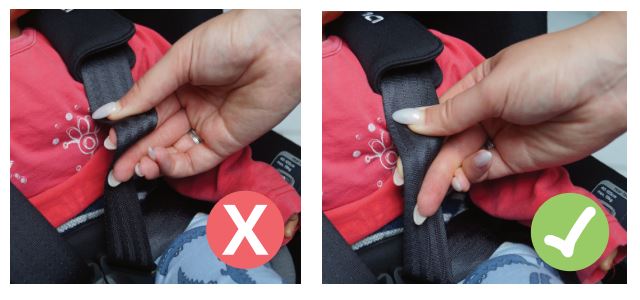
Now try to pinch the shoulder strap between your thumb and index finger and form a small loop.
4. Can you pinch the strap?
If you can, the harness is still too loose. Make sure to tighten it further.
Important: The goal is for the harness to fit snugly enough that you cannot pinch a noticeable loop of the harness strap between your thumb and index finger. (See image)
Why Is a Tight Harness So Important?
In an accident, every second counts – and so does every centimetre that the body can move uncontrollably.
If the harness is too loose, there is too much slack in the event of a collision. Your child’s body can therefore be thrown further forward, or in the worst case, your child could slip out of the harness system.
This can result in serious injuries, particularly to the head and neck.
A correctly fitted and tight harness, on the other hand, keeps the body better positioned and can therefore significantly reduce the forces placed on the body during a collision.
“Isn’t That Too Tight? Doesn’t It Hurt?”
No, it is not too tight. However, some children first need to get used to being secured this firmly.
The problem is often not the harness itself, but the clothing underneath it.
Thick clothing, such as winter jackets, should be avoided underneath the harness system.
Thick clothing creates additional space between the child’s body and the harness. In an accident, the material can compress significantly, meaning that the harness can be considerably looser at the crucial moment than it initially appeared when the child was buckled in. This creates slack in the harness, which can lead to injuries in the event of an accident.
Better: Take off thick jackets before securing your child.
Our Tip for Your Next Car Journey
Whether you are travelling with your own car seat or renting a car seat from us in Mallorca, Fuerteventura or Gran Canaria for your holiday:
Take a moment before every journey to check the car seat and the harness system.
A child car seat can only provide optimal protection if it is correctly installed and your child is properly secured.